


Historical U.S. Labor Market Context & Current Baseline
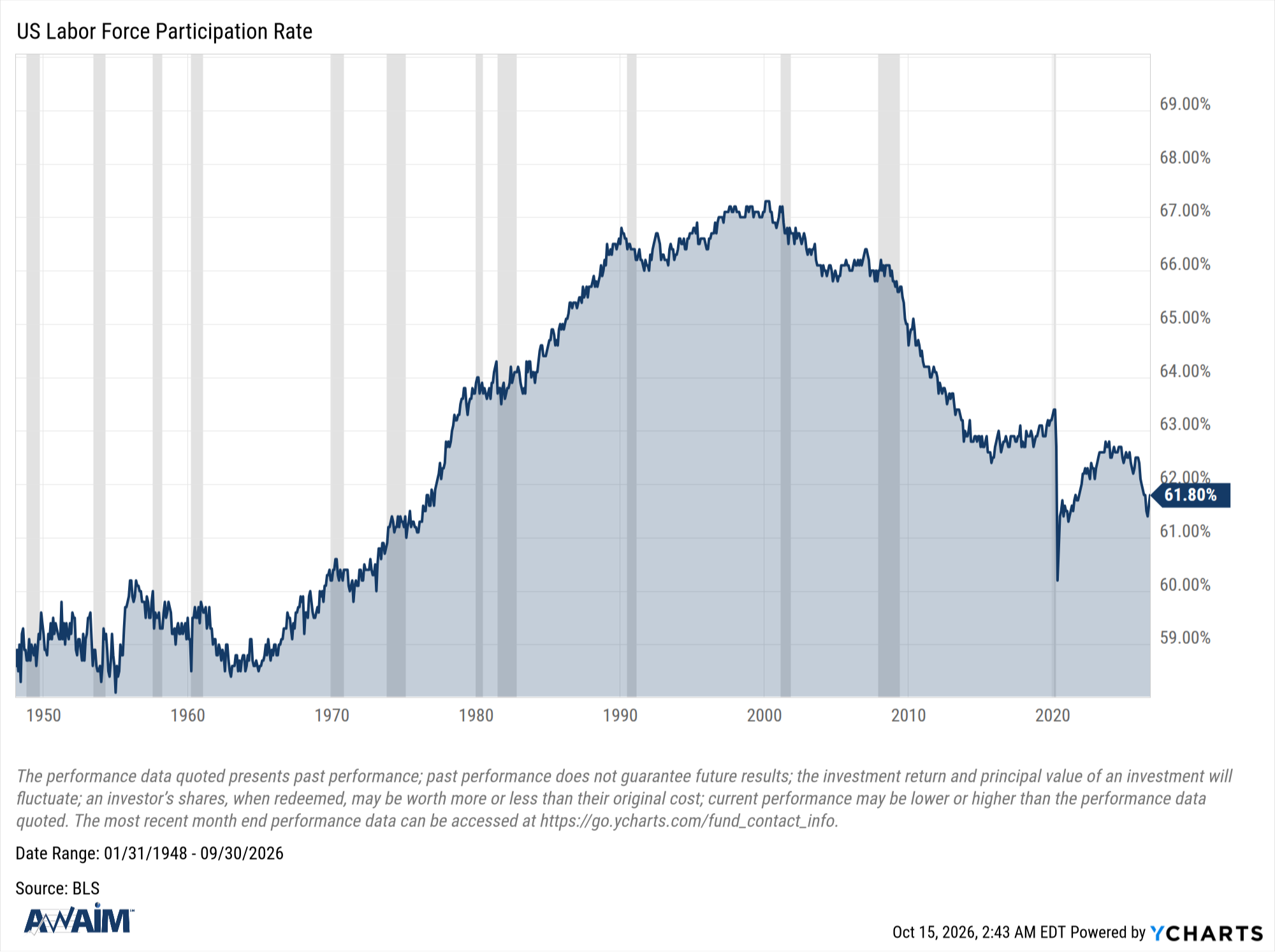
The chart above displays the U.S. Labor Force Participation Rate (LFPR) from 1948 through late 2026. Over this nearly eight-decade span, three distinct eras emerge:
- The Post-WWII Growth Era (1950s–1990s): Labor force participation rose steadily from below 59% to a peak near 67.3% in early 2000. This surge was primarily driven by the mass entry of women into the formal workforce and the demographic momentum of the Baby Boom generation.
- Structural Decline (2000–2020): Following the 2000 peak, participation trended downward, accelerated by the 2008 Financial Crisis. Key factors included the aging Baby Boomer cohort entering retirement, structural shifts away from manufacturing, and lower participation among prime-age men.
- The Post-Pandemic Plateau (2020–Present): After dropping sharply during the COVID-19 shock in 2020, participation recovered partially but stabilized around 61.8%–62.5%.
The AI Impact: Economic Drivers and Structural Trends
As AI adoption expands across industries, its interaction with labor force dynamics will shape the trajectory of participation through several key mechanisms:
1. Automation vs. Augmentation
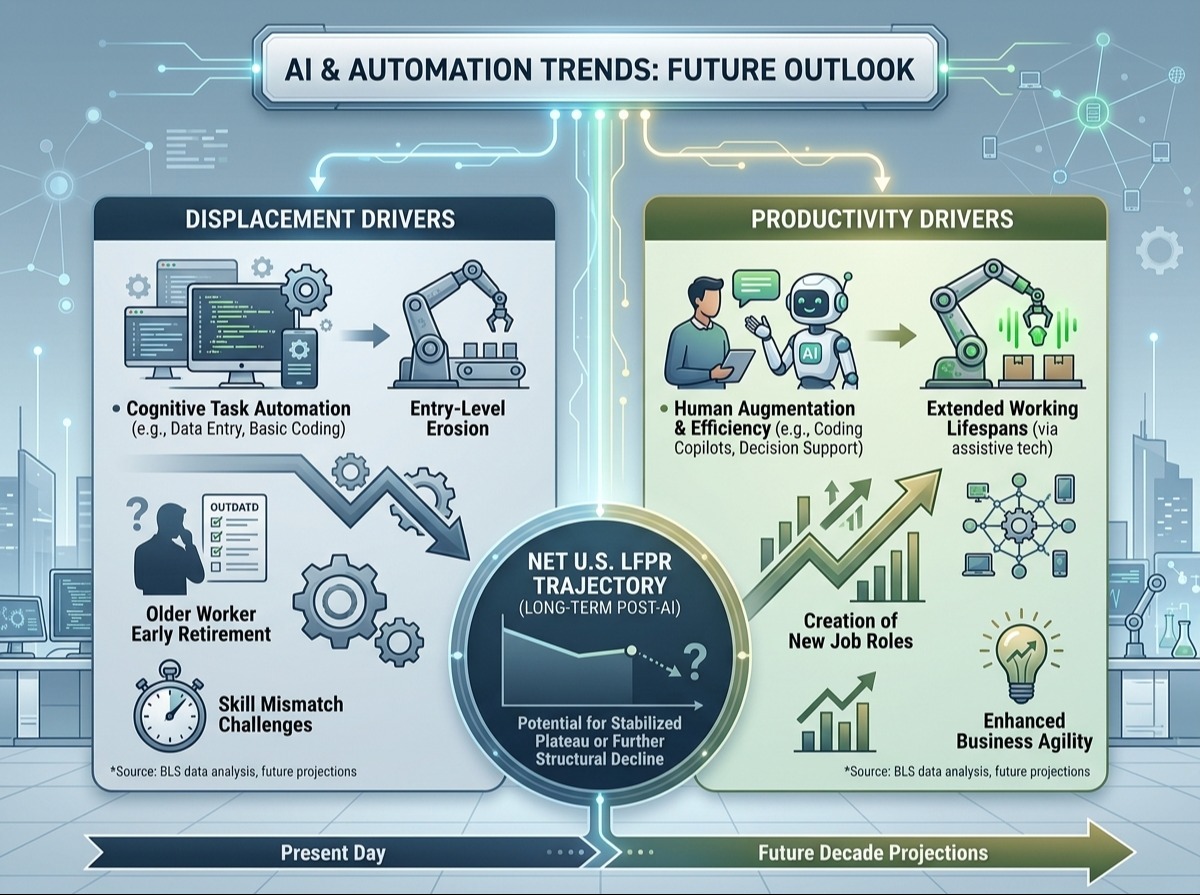
Historically, automation affected primarily routine manual or clerical labor. Modern generative and agentic AI systems target cognitive, knowledge-based, and creative tasks (e.g., coding, data analysis, customer support, legal research).
- Augmentation: Workers leverage AI tools to achieve higher output per hour, increasing productivity without necessarily reducing headcount.
- Displacement: Tasks that can be fully automated reduce demand for traditional roles, forcing displaced workers to either reskill, transition to service/physical sectors, or exit the labor force entirely.
2. Demographic Headwinds vs. AI Productivity
The demographic aging of developed economies naturally exerts downward pressure on LFPR. AI deployment offers two competing effects on this demographic shift:
- Accelerated Exit: Older or non-technical workers facing rapid technological transitions may opt for early retirement rather than extensive retraining.
- Prolonged Participation: AI-assisted remote work, reduced physical strain, and adaptive tools may allow older or disabled individuals to remain active in the workforce longer than previously possible.
3. Structural Reconfiguration of Entry-Level Roles
Because AI tools excel at tasks typically assigned to entry-level professionals (e.g., basic drafting, preliminary research, routine coding), the traditional pathway into many knowledge professions is shifting. If fewer junior roles are created, young adults may experience longer delays in labor market entry or higher rates of detachment from formal employment.
Future Scenarios for the Labor Force Participation Rate
Looking forward, economic analyses point toward three main scenarios for how AI could shape LFPR over the coming decades:
Scenario | Macro Drivers | Expected LFPR Impact | Key Indicators |
Controlled Integration (Baseline) | Managed AI adoption alongside reskilling programs and continuous job creation in high-touch/physical services. | Gradual Decline / Stabilization (58% – 61%) | Stable prime-age participation; growth in human-centric and physical-labor industries. |
Disruption & Displacement | Rapid displacement of cognitive workers faster than the broader economy creates replacement roles; accelerated early retirements. | Sharper Decline (< 58%) | Rising friction in worker re-allocation; elevated rates of workers exiting the active workforce. |
Productivity Expansion | AI tools lower barriers to entry for new business creation, enabling gig, entrepreneurial, and flexible participation models. | Modest Rebound / Stabilization (> 63%) | Surge in self-employment, micro-entrepreneurship, and flexible gig platform participation. |
Key Takeaways
While historical declines in the U.S. labor force participation rate were largely driven by demographics and structural economic shifts, the future trajectory will depend significantly on how labor markets adapt to AI-driven productivity gains.
Whether AI leads to persistent workforce contraction or structural transformation depends less on the technology itself and more on policy responses, institutional adaptability, and the pace at which education and retraining systems evolve.
© Copyright 2026, AWAIM®